Showing posts with label Wisteria. Show all posts
Showing posts with label Wisteria. Show all posts
Sunday, April 10, 2011
Wisteria
33 Amazing pictures here- http://ewainthegarden.blogspot.com/2009/04/33-amazing-pictures-hand-picked-vine.html

VERSATILE WISTERIA VINES
Wisteria is a colorful, versatile, fast growing, easy to care for vine. The hanging clusters of flowers provide quite a show in the late spring.
It can be grown as a vine, a tree or a shrub. It is an ideal vine to use against a wall, fence, trellis or arbor. With a little special training it can be coaxed into a tree. With pruning it can be maintained as a shrub. VARIETIES
 The two most common species are W. floribunda , (the Japanese one) and W. sinensis, (the Chinese one). Here' the difference between the two:
Wisteria floribunda (Japanese wisteria) - has large 12 to 18-inch clusters of flowers. It usually flowers as the leaves are developing. The fragrant flower clusters come in violet-blue, white, pink and several in between shades. It flowers in May and June.
Wisteria sinensis (Chinese wisteria) - it flowers before the vine begins to leaf-out. Flowers are a bit smaller, ranging from 9 to 12 inches in length. Most have a mild sweet fragance. The white and violet-blue varieties are the most popular. This type tends to bloom at an earlier age and most open at the same time creating quite a flowering display in May.
There are other species, but these two seem to be the most popular and readily available in the west. However, the others do grow here and you will occasionally find them in specialty gardens.
LOCATION AND PLANTING
Most nurseries and garden centers have their finest selection of vines in late winter and throughout the spring. Contain grown vines are also often available at other times throughout the year.
Wisteria loves a bright sunny spot in the garden. However, we have three vines in our garden and one is in full sun, the other two in part sun and shade. All three do equally well.
Wisteria is difficult to move once established, so it is important to plant where it can remain undisturbed. I should rephrase this comment, because we moved an old one, and it transplanted fine, but it took the plant almost five years to fully recoup.
Wisteria is one plant that seems to thrive on a certain amount of neglect. However, planting time is the only time you can get nutrients and soil conditioners directly to the root zone. So mix generous amounts of compost, peat moss or processed manure with your existing soil. Provide good drainage and just a little bit of transplanting fertilizer. Be certain to provide staking support immediately. Otherwise, the weight of the vines could cause them to break from the main stem as the plant grows.
TREE WISTERIA
To train a young vine into a tree, simply prune back all vines, except the strongest, sturdiest one. Stake it and train it upright, supporting it so it will grow as a tree trunk. Then when it reaches the desired height simply prune out the tip growth. From this point it should branch out and form a tree. Use a husky pipe or 4 X4" post to secure the trunk and keep it from wind whipping or breaking. As you are training the trunk upright, you may find a few shoots trying to form on the trunk, keep them pinched off, or they will form side shoots and the tree effect will be lost.
PRUNING
Severe pruning, if needed, is done during the winter dormant season months of November, December, January and February. Some July pruning can be done, to help control the rampant growth of the vines. Otherwise, you end up with a tangled mess of intertwined vines. The dormant season pruning is the severe pruning, when one should cut the leader vines back to the desired height. Then prune the side shoots (those growing from the main leaders) back to the second or third dormant bud. This is where good judgment must be used, because the flower buds form the previous summer, and if you prune too severely, of course you will be cutting off all the potential new flower buds. I think the most important consideration is proper pruning at the correct time. If allowed to grow unattended the vines may reach 50 feet or more.
FERTILIZING AND WATERING
 I put these two factors together, because if you over-water or over-fertilize wisteria vines, your chance of getting them to flower is greatly reduced. As mentioned earlier, wisteria thrives on a certain amount of neglect. The prettiest wisteria and grapevines I have ever seen were around an abandon house, where they existed on what 'Mother Nature' provided in moisture, sun and nutrients.
 However, if the vines are off-color or obviously in need of feeding, feed them with a 'Rose type' plant food. The best times to feed them is in late winter or mid-spring.
Water sparingly throughout the summer. If there's a prolonged warm (or hot) spell, they obviously will need watering attention. If a few leaves show signs of wilting, then be certain they get the moisture they need. The roots are quite robust and over a period of time may find their own source of moisture.
VINES THAT DON'T FLOWER
If you have an old plant that has not been flowering as well as it should, root pruning in the fall will slow growth and often aid in the development of additional flowers in future years.
PROPAGATION OF WISTERIA
The vines you purchase have usually been grafted, layered or taken from cuttings. So if you want to start additional vines from your own plant, layering the lower side shoots is the best procedure to follow. Do this in the spring. Actually lower growing vines will often come into contact with the soil and root on their own. Simply cut those rooted vines away from the mother plant and you have a new vine. Best time to do this is in springtime.
A 12 to 18 inch tip of the vine can also often be started in water alone. If you add a little rooting hormone to the water, it may help speed up the rooting process. Smaller cuttings 6 to 9 inches long can also be started in soil. Whether you do it in soil or water, the best time is to take these cuttings in the late winter, just before the new growth starts.
New vines can also be started from seed, but seedlings are slow to flower. It may take 8 to 10 years for the first blooms to appear.
INSECT AND DISEASES
Wisteria is a pretty trouble free vine and is seldom bothered by insects and only occasionally by problems like mildew. Should problems occur, consult your local Certified Nursery-person for specific recommendations. http://www.humeseeds.com/efwist.htm
World’s largest wisteria vine
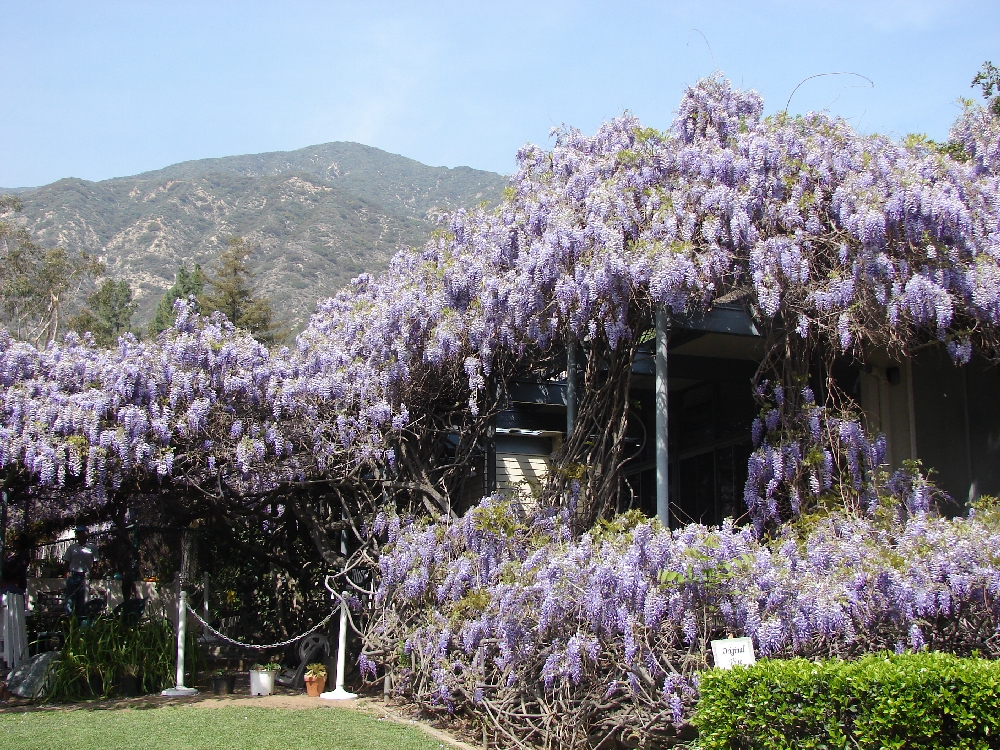
Incidentally, Sierra Madre is also home to the world’s largest wisteria vine. In 1894, Mrs. Alice Brugman went to neighboring Monrovia and purchase the flowering vine in a one-gallon pot for 75 cents. By 1931, the wisteria had outgrown its arbors and had crushed the house, so a new house was built 200 feet away. Today it measures more than an acre and weighs 250 tons. The annual Wisteria Festival has been held in March each year since 1918, and tickets are still available if you’d like to visit the world’s largest blossoming plant at this year’s village celebration on March 20.

http://tripfield.wordpress.com/2011/02/22/5-lemoranges-3-dekopan-2-seville-trees-and-an-overgrown-fruitless-thing/
http://tripfield.wordpress.com/2011/02/22/5-lemoranges-3-dekopan-2-seville-trees-and-an-overgrown-fruitless-thing/
The World's Largest Wisteria Vine and Its History
One of the Seven Horticultural Wonders of the World The world's largest wisteria vine grows in Sierra Madre, California. There is even a festival honoring this mammoth wisteria vine and the plant's namesake. The Wistaria Festival takes place annually in this
The world's largest wisteria vine grows in Sierra Madre, California. There is even a festival honoring this mammoth wisteria vine and the plant's namesake. The Wistaria Festival takes place annually in this community in California that is home to the more than 100 year old wisteria vine.
The popular and showy wisteria vine was originally named Glycinia after the word "glykys," which is Greek for sweet. An American naturalist, Thomas Nuttall, renamed the wisteria in the 1800s to honor a renowned botanist at the University of Pennsylvania.
Even though the plant was named in honor of Professor Casper Wistar, his named was accidentally misspelled and the 'a' was replaced with an 'e'. The name was never changed, and wisteria has been the common and botanical name of this plant ever since.
The masterpiece wisteria vine growing in California is so large that it has received a place in the 'The Guinness Book of Records'. It has been named as "The largest blossoming plant in the world." This amazing wisteria vine is more than one acre in size and weighs 250 tons.
It has more than 1.5 million blossoms every year with 40 blooms per square foot. The branches of this unbelievable wisteria vine reach an amazing 500 feet long. Horticultural experts have estimated the branches can grow 24 inches in 24 hours.
The world's largest wisteria vine is a beautiful lavender Chinese variety. It was planted in 1894 by William and Alice Brugman. The couple bought the plant at a local nursery for 75 cents and planted it near their home. They eventually sold their home twenty years after planting the wisteria. H. T. Fennel bought the home and fell in love with the wisteria vine and began building arbors for it. The wisteria vine continued growing and became too large for the supports erected by Mr. Fennel. The huge plant eventually began growing onto the house. The roof could not support the weight of the giant wisteria vine and finally the roof collapsed. The house was demolished in 1931. They built a new house close by. New supports kept being added for the wisteria and it was allowed to continue growing.
This extraordinary wisteria vine was honored with its first festival in 1918. This tradition has continued every year since. The festival has approximately 15,000 visitors each spring to celebrate the world's largest wisteria vine.
This magnificent antique wisteria vine has been named one of the seven horticultural wonders of the world. It takes an honorably place with the gardens of Buckingham Palace, the redwood forests of Sequoia National Park, Brazil's tropical jungle in the Amazon Valley, India's gardens of the Taj Mahal, Japan's Yokohama rockgardens, and Mexico's Xochimilco floating gardens. http://www.associatedcontent.com/article/138133/the_worlds_largest_wisteria_vine_and_pg2.html?cat=32
The popular and showy wisteria vine was originally named Glycinia after the word "glykys," which is Greek for sweet. An American naturalist, Thomas Nuttall, renamed the wisteria in the 1800s to honor a renowned botanist at the University of Pennsylvania.
Even though the plant was named in honor of Professor Casper Wistar, his named was accidentally misspelled and the 'a' was replaced with an 'e'. The name was never changed, and wisteria has been the common and botanical name of this plant ever since.
The masterpiece wisteria vine growing in California is so large that it has received a place in the 'The Guinness Book of Records'. It has been named as "The largest blossoming plant in the world." This amazing wisteria vine is more than one acre in size and weighs 250 tons.
It has more than 1.5 million blossoms every year with 40 blooms per square foot. The branches of this unbelievable wisteria vine reach an amazing 500 feet long. Horticultural experts have estimated the branches can grow 24 inches in 24 hours.
The world's largest wisteria vine is a beautiful lavender Chinese variety. It was planted in 1894 by William and Alice Brugman. The couple bought the plant at a local nursery for 75 cents and planted it near their home. They eventually sold their home twenty years after planting the wisteria. H. T. Fennel bought the home and fell in love with the wisteria vine and began building arbors for it. The wisteria vine continued growing and became too large for the supports erected by Mr. Fennel. The huge plant eventually began growing onto the house. The roof could not support the weight of the giant wisteria vine and finally the roof collapsed. The house was demolished in 1931. They built a new house close by. New supports kept being added for the wisteria and it was allowed to continue growing.
This extraordinary wisteria vine was honored with its first festival in 1918. This tradition has continued every year since. The festival has approximately 15,000 visitors each spring to celebrate the world's largest wisteria vine.
This magnificent antique wisteria vine has been named one of the seven horticultural wonders of the world. It takes an honorably place with the gardens of Buckingham Palace, the redwood forests of Sequoia National Park, Brazil's tropical jungle in the Amazon Valley, India's gardens of the Taj Mahal, Japan's Yokohama rockgardens, and Mexico's Xochimilco floating gardens. http://www.associatedcontent.com/article/138133/the_worlds_largest_wisteria_vine_and_pg2.html?cat=32
Giant Wisteria Trees
Colossal Wisteria Tree of Auburn

This 100-year-old, 100-foot-tall Wisteria "bush" twists and climbs to the top of four Ponderosa pine trees located on Linden Avenue in Auburn, California. The best time to view this spectacular display of color is early April.
The trunk of the Wisteria is almost as big around as the Ponderosa pine tree that it climbs!
So far, no one has challenged our claim that this is the Tallest Wisteria in the World.
Field staff Randy was able to take the first ever picture of the entire mass of the Wisteria from ground to apex (293 KB). Preliminary tests suggest that this is not a "robo-treenenna".

Wisteria Hysteria

Auburn's famous Wisteria tree/bush/vine was featured on the April 2006 cover of Sierra Heritage Magazine. Here's an excerpt from their cover story:
"...We don't hire models to pose for us... The cover of this issue is a good example... When Kathleen Sailor showed us her shot of the beautiful century-old Wisteria vine right here in our backyard, we knew our search was over... Mrs. Francis, the original owner of the house in the background, planted the vine over 100 years ago, and she must have had some kind of green thumb, because it still seems to be growing strong..."
The Tallest Deadest Wisteria in the World

The second tallest Wisteria in the world is dead! The Giant Wisteria of Colfax climbs and twists 75-feet to the top of two Ponderosa pine trees on the east side of Ben Taylor Road across from Colfax High School. At one time it rivaled the famous Giant Wisteria of Auburn in height and beauty.
Unfortunately, the Giant Wisteria of Colfax was recently separated from its' roots due to activities associated with nearby construction which resulted in a slow death to the leaves and flowers.

Now that the world's second tallest wisteria is dead, we plan to focus more attention on the world's third tallest wisteria which is located on Meadow Vista Road in Meadow Vista.
Carnivorous Wisteria
In 1891, at around the time this giant Wisteria-to-be was planted in Auburn, an author named Charlotte Perkins Gilman wrote a ghost story called "The Giant Wisteria". Published in a Victorian issue of New England Magazine, the story regards a huge weird house plant out of which an infant's ghost rises. If not for that story, we wouldn't even know that giant Carnivorous Wisterias existed. http://www.ruralmysteries.com/wisteria.shtml
Purple Wisteria Blooms are Everywhere in Auburn

I love Wisteria Blooms in the Spring. They grow like weeds down here in the south but we actually planted one a few years ago. It has grown into this huge vine that wants to eat the house, but right now, it is totally covered in beautiful purple blooms and smells incredible. Every year I take photos of this plant and every year the blooms are better and better but my photos end up all looking the same. This year I tried something totally different, shooting Wisteria blooms from the ground using the skylit sun as a background, creating some massive backlit conditions. I love the way they turned out and they aren’t your typical shoot the flower shot.
For a little contrast I posted some “normal” shots below as well but I love how the backlit conditions adds something totally different to this particular bloom, and today, it’s the photo of the day.


 http://www.scottfillmer.com/2011/03/20/purple-wisteria-blooms/
Thursday, April 7, 2011
Wisteria Blossoms

We are reminded at every turn of the easy mastery that fills Genji; there’s hardly a Western work to rival it for endless virtuoso displays of seemingly offhand brilliance. Middlemarch comes close, but there’s virtually nothing in it that can properly be called comedy (and certainly nothing that’s actually funny, at least that the author intended to be), and likewise the tragic elements of Don Quixote seem almost sewn onto the comedic elements – there’s hardly any sense of the flow that characterizes Genji from start to finish, the musical, at times almost unbearably modulation events and characters are given, to be many things – some contradictory – at the same time. Genji is so filled with these stunning subtleties that the way we’re reading it here – slowly, over the course of a deliberate, thoughtful summer – is not only ideal but very nearly essential: in a book where a world of meaning can be implied in the opening of a fan in just a certain way, much will be lost to haste.
We’re past the half-way point by now, not only of our summer but of our “Summer of Genji,” and great, epic chapters lie before us – and yet which of us isn’t finding dozens of old chapters, characters, and scenes sticking in our memory? Just the title of Chapter 33 – Fuji No Uraba, given by Tyler as “New Wisteria Leaves” – strikes a floral chord that reminds me of the gillyflowers of Tokonatsu (“The Pink”) and its delightful, pitch-perfect portrait of To no Chujo’s newfound daughter Omi no Kimi with her impulsive behavior that’s at once so comically backwoods and so guilelessly charming. We can share her father’s affectionate despair over her even while we like her – both views of the character are encouraged, even though a lesser writer would worry they’d annihilate each other, dramatically speaking.
The beginning section of “New Wisteria Leaves” features another such bravura set-piece, the evening party given by To no Chujo ostensibly to celebrate the spectacular blossoming of his wisteria (in a charming – and yet double-edged – aside, he mentions that he favors them because of all the blossoms of spring, they’re the only ones who don’t betray admiration by immediately fading away) but really to give Genji’s son Yugiri permission to take his daughter at last.
Much wine is served at this party, and much poetry is recited (our narrator tactfully hints that the quality of the latter bore an inverse relationship to the quantity of the former, an old complaint Homer would have found familiar), and meanings and intentions are doubled, halved, folded in and in upon each other until all we can know for certain are outcomes (the boy gets the girl).
But the party itself is a perfect little fascination such as only Murasaki Shikibu (and Jane Austen, of course, the mighty exception to all literary East-over-West hyperventilating) could craft, where characters are perfectly sober but acting drunk in order to say things propriety might not let them say while sober, and where characters are actually drunk but still calculating the interpersonal balances of every single encounter to the tenth decimal. And at the heart of it all is Yugiri, the stunningly handsome teenage son of Genji.
As interesting as I think it is that we’re told repeatedly that Genji looks young enough to be Yugiri’s brother (and that they look enough alike to be almost interchangeable, a staple of comic literature here wrought in a slightly different metal), what fascinates me most is To no Chujo’s little declaration to his ladies when Yugiri first arrives at his house. Before the young man has seen his host, To no Chujo has seen him, and in addition to the usual superlatives about how good-looking the young man is, there’s a tell-tale contrast: To no Chujo points out that whereas Genji likes his ease (and by implication has always lacked a certain mental rigor), Genji’s son, equally good-looking, has studied hard and filled himself with an ethic of purpose that if anything gives him the edge over his illustrious father.
This little glimpse of Genji has the ironic secondary effect of making us retroactively cherish some of the very attitudes of his for which we were in earlier chapters so tempted to deplore him, and its edge is sharpened by the fact that To no Chujo himself has always been a bit of a sour-puss: do we believe him when he says the boy’s greater focus on his duty makes him more attractive, or do we disbelieve him and like Genji all the more for the comment?
Murasaki Shikibu’s quiet mastery allows us to do both simultaneously, and I’m luxuriating in that. It’s good to savor such exquisite inconsequentialities before diving into the epic goings-on of our next few chapters! And don’t underestimate our author: that effect too, so wisteria-like in its nature, is no doubt perfectly intended …
–Steve Donoghue http://summergenji.wordpress.com/2010/08/04/wisteria-blossoms/
Vine validation
 It's a no-brainer -- if you've got a wisteria, you want it to bloom.
A recent question about getting wisteria and trumpet vines to bloom:
"Will someone please tell me how to get wisteria and trumpet vines to bloom? We've had them planted now for three years and nary a bloom, despite dumping buckets of Miracle-Gro and 'bloom' products on them. Thanks for your help."
Even though conventional wisdom has wisteria blooming in three years, mine took at least five to really get going. The type I chose to plant is a Chinese wisteria (supposedly W. sinensis 'Black Dragon,' which is supposed to have dark purple flowers, but it isn't). Chinese wisteria blooms on bare branches before foliage emerges, and the flowers open all at once, though they're smaller than the blooms of Japanese wisteria (W. floribunda), which open gradually from the top down and after leaves come out.
Here are a couple of additional reasons why yours hasn't bloomed yet: Don't fertilize at all. They don't like it; fertilizer will encourage foliage growth to the detriment of flowering. Prune A LOT. I definitely found that pruning often will force much more bloom. I prune mine at least four times a year, sometimes more. And even though directions for pruning wisteria seem very complicated, I say cut it back anyway you want ... the harder the better. I was so intimidated by how to prune a wisteria at first that I didn't do it. Then I tried following instructions and got really confused. Finally, I just started cutting away. And guess what? It started blooming abundantly.
One last thing. It is always better to buy a wisteria that is blooming. Not only will you get the color you want, you'll be sure it blooms. Seedlings (as opposed to grafted or cutting-grown plants) can take much longer to bloom -- 10-15 years.
On to trumpet vine (most often Campsis radicans or a cultivar of C. radicans). Like wisteria, these vigorous vines look like they need to be pruned all year long. However, since they bloom on new wood (this year's growth), they should only be pruned in winter or very early spring.
If anyone else has advice, please chime in. http://blog.oregonlive.com/kympokorny/2007/07/vine_validation.html
Subscribe to:
Posts (Atom)