Showing posts with label Edible Asian Garden. Show all posts

Thursday, April 7, 2011

Growing Ginger


Grow-Herbs.net - Herb Growing the Easy Way


Growing GingerTo be successful in Growing Ginger you need to be aware and remember that it is a tropical plant and therefore will flourish in tropical type condition such as rich moist soil, warmth, humidity and dappled sunlight.
Ginger is very susceptible to direct sun, frost, strong winds and water logged soil.
The easiest way to start growing ginger is to obtain a fresh root from a super market in the spring. Make sure you select a good plump root and look for those that have developed growth buds, ‘eyes‘.
Soak the roots in water overnight to remove any of the growth retardants that may have been used by the commercial growers.
To improve chances of success the soil has to be rich enough to feed the ginger. Mix 1 part compost with 1 part of sandy garden soil, by using this mixture it will ensure that the growing medium is free draining, yet holds moisture and gives nutrients. If your garden soil is heavy it is advisable to make a raised bed for planting. 
Plant the ginger in late winter or early spring, making sure you chose a site that is not in full sun and protected from the wind. Plant approximately 8cm deep, with the growing buds facing upwards. Plant 15cm apart; as the root grows underground it does not mind being crowed. Gradually over time the clump will become dense and bigger and bigger unless it’s harvested.
While growing ginger needs lots of moisture, care must be taken never to let the soil dry out, but over watering will take any nutrients away with it. Use a thick covering of mulch to help retain moisture; this will also keep the weeds at bay. Spraying or misting is required if the air is too dry, ginger thrives in humidity, but careful positioning should ensure that these requirements are naturally met.
If you live in area that has heavy rains you will need to replace the nutrients into the ground which the rains have washed away. Dig in slow release organic fertilizer when planting and after that use organic liquid fertilizers such as fish fertilizer every few weeks.
When the weather starts to cool down at the end of the summer the plant will start to die down, you must stop watering and let the ground dry out, this will encourage the plant to form its rhizomes (the real name that we all call ginger ‘root’ is in fact the rhizome).
The ginger is ready to harvest once all the leaves have died down.
You can harvest the ginger root when it is green, at about 4 months old, but this will have less favor than the matured root, the root will be mature between 8-10 months after planting. It is advisable, however, to let the plant establish itself by not harvesting the first year.
Depending where you live your ginger may not survive the winter, bring it in side if possible and let it dry out, otherwise it will rot, and if you are very lucky you may be able to re-start Growing Ginger the following spring.   http://grow-herbs.net/growing_ginger.php

Daikon seeds and Nimono recipe


Today was a perfect day to go out and start Flowers and seed window shopping...
Actually for seeds was shopping, for the flowers I will do it by the end of March.
Look like I wasn't alone. Many guys were also doing gardening shopping. Figure :))
First stop, Loews and then Home Depot.
Off course I start to get Herbs seeds for my cooking, and my joy was finding daikon seeds.

I will try to grow daikon, this is my spring challenge, the only problem is finding a tall vase. No problem at all, so many tall vases.....is everyone growing Daikon???? Well,
before I do write any suggestion and please leave a comment.
But before you do, there is a simple recipe and I challenge all of you to cook it.
Let's see how many will prepare it, we can exchange information during our getting together lunch.

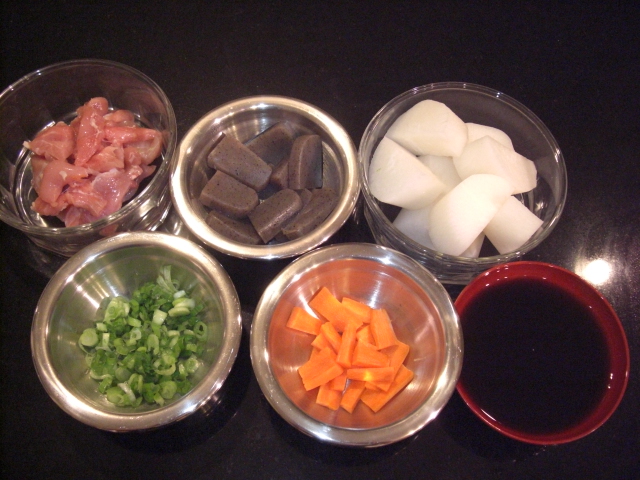
Chicken and daikon Nimono


Yield: 2 servings
Time: 40 minutes
Ingredients
  • 1/4 daikon (about 1 lb, cut into 2″ thick half circles)
  • 1/3 lb boneless thigh chicken
  • 1/3 cup diced carrots
  • 1/2 konnyaku (1/4 lb)
  • 1/4 cup green onion (chopped)
Spices
  • 3 tbsp soy sauce
  • 2 tbsp sake
  • 2 tbsp mirin
  • 1 tsp hon-dashi (soup stock powder)
  • 2 tbsp sugar
Preparation
  1. Mix all spices in a bowl (soy sauce, sake, mirin, hondashi and sugar).
  2. Boil konnyaku for 3 minutes, strain, and set aside.
  3. Add 3 cups of water and daikon in a sauce pan and bring to a boil. Cook for 5 minutes.
  4. Remove daikon, set aside, then add chicken and boil for 5 minutes. Skim the top
  5. Add mixed spices, stir then add daikon, konnyaku, and carrot, cover with lid, and cook for 20 minutes over medium heat.
  6. Add green onions and serve.
   http://justnihonkai.blogspot.com/

Lemongrass Tea


These are the lemongrass plants growing profusely in pots of my balcony 'garden'. This fragrant plant is easy to grow, I have more than enough that I need for everyday cooking. I often share with family and friends several stalks at a time or else, the pots would not be able to hold all the leaves!

I am happy I have this plant so that I can easily get them fresh. Most of what are available in the market are already dried ones. They do not lose their flavor though, so even the dried lemongrass can still be used for cooking.

Usually, we use the stalk, the white part near the root (where there is more concentration of the citrusy smell) as flavoring for cooking soups, curries or stews. It is used for stuffing roast chicken, for pounding into sauces. What about the leaves? Sometimes, we include those into cooking as well. But more often than not, we infuse the leaves into tea.

It is very simple actually. I use 10 leaves, cut them up into 2 to 3 inches. Wash them well and boil them in a liter of water. The resulting liquid is very fragrant, rich lemon gold in color, very refreshing!


You can drink it hot or cold. (I prefer it hot, no sugar added.) You can drink it as is, or add a simple sugar syrup, or add a sugar substitute such as stevia, if preferred.

To make sugar syrup, just boil 1 cup water with 1 cup whit sugar until sugar is melted and the liquid turns a little syrupy consistency. Add to any of your preferred drinks.

Last week, a friend forwarded to me an email citing a study done by the Ben Gurion University at Negev, Israel. The study shows lemongrass can be a cure for cancer. Read the full transcript here. The study says that lemongrass contains "citral" the component that gives lemongrass its citrusy scent and aroma; and that this component causes the cancer cells in our body to die. The cancer cells die while the healthy cells live, thus helping the cancer patient to be healed.

Hubby and I tend to believe that the anti-cancer properties of the lemongrass is true, not just because of the testimonies of many people but because we believe that God has indeed gifted us many natural herbs and medicines that can be found in nature, in plants. Further studies are being conducted to confirm this initial findings. Meanwhile, we can enjoy this delicious, refreshing lemony tea that may have healing effects on our bodies as well.


 http://heartandhearth.blogspot.com/2008/07/lemongrass-tea.html